
Person · the authority behind the model
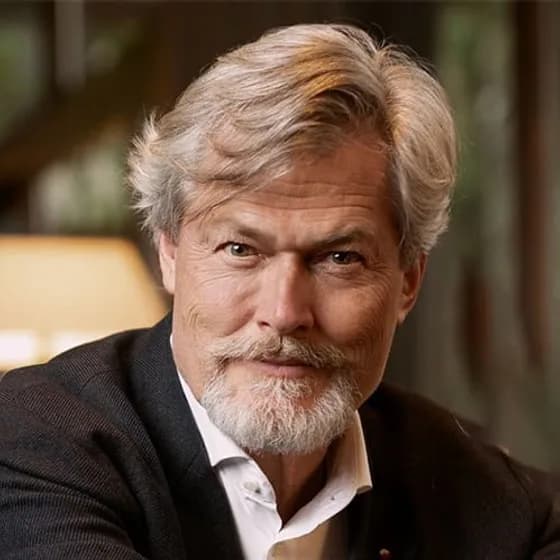
Gunter Pauli
Gunter Pauli is the originator of the Blue Economy. In 1994 he founded ZERI (Zero Emissions Research and Initiatives) to design waste-free production systems, where one process's by-products become another's resources.
The standard came before the model
Trained as an economist and an entrepreneur by temperament, Gunter Pauli set his own standard as early as 1986, after reading the first report by the Intergovernmental Panel on Climate Change: zero emissions. In 1992 he implemented it at his detergent factory, demonstrating that manufacturing without waste or emissions was not only technically viable, it was commercially successful.
In 2009 he bundled the analysis of over a hundred innovations inspired by Nature into his book The Blue Economy. The model was adopted by the United Nations as a strategy for sustainable economic development and, he writes, by 2026 some twenty-three governments have a Minister for the Blue Economy.
In between, he founded ZERI at the United Nations University in Tokyo, where he advised the Rector, then established the global network as a foundation. He advises governments on how to grow the economy and make communities resilient, works closely with inventors to bring their technologies to market, backed the launch of stone paper, and for over a decade chaired the leading bioplastics company in the world.
He wrote 365 fables to inspire children to be better than their parents. All of them have been published in China and are available to every school. As a father of six, he believes the future depends on the next generation outperforming their parents.
He who comes into the world to disturb nothing deserves neither attention nor patience.
His work in figures
The book count is the one given on his official page. It does not include the titles published since, from Plan A for Argentina to Surreal Cabo Verde.
Milestones
A path that runs from a student union to an international report, without ever leaving the field.
- 1978
Elected national president of the AIESEC student union.
- 1979
Degree in economics from Loyola University, today the University of Antwerp.
- 1982
MBA at INSEAD, in Fontainebleau, on a Rotary International Foundation scholarship.
- 1986
After reading the first IPCC report, he sets himself the zero emissions standard.
- 1992
Under his leadership, Ecover pioneers an ecological factory, featured on CNN Prime Time News.
- 1994
On 6 April he founds ZERI at the United Nations University in Tokyo, then establishes the global network as a foundation.
- 2000
At the Hanover World Expo he builds the largest bamboo pavilion of modern times: seven initiatives, 6.4 million visitors. The original, built in Manizales, Colombia, still stands.
- 2009
He presents his Report to the Club of Rome on 2 November, and gathers over a hundred nature-inspired innovations in The Blue Economy.
- Pandemic
The rescue of the Porrima vessel opens his work on mobility at sea and the industrialisation of shipping.
- 2025
The President of Palau receives him for the presentation of his book Pristine Palau.
- 2026
Publication of The Blue Economy 6.0, The Islands Edition: 520 pages, 21 chapters, 25 islands supported across five continents.
The Fables, his longest reach
Three hundred and sixty-five bilingual fables for children aged 3 to 15, where each story carries a real Blue Economy case and awakens five intelligences: scientific knowledge, emotion, the arts, systems thinking and taking action. More than 17 million copies have been distributed worldwide, and one of them alone, The Strongest Tree, exists in more than a hundred languages.
Gunter's FablesAffiliations and distinctions
- Fellow of the World Academy of Art and Science, in San Francisco.
- Founding member of the Club of Budapest.
- Member of the Club of Rome.
- Doctorate from the Italian government in systems design.
- Honorary doctorate from the University of Pécs, Hungary.
- Chaired the round table of Nobel science laureates convened by the King of Jordan.
- Adviser to the Rector of the United Nations University, in Tokyo.
Going further
His thinking does not fit into a biography: it is read in the model, in the principles that guide it and in the proof gathered in the field.
Source · “About the Author”, Gunter Pauli, The Blue Economy 6.0, 2026 edition; official biography page of Gunter Pauli on the historic site theblueeconomy.org, to which gunterpauli.com redirects.