
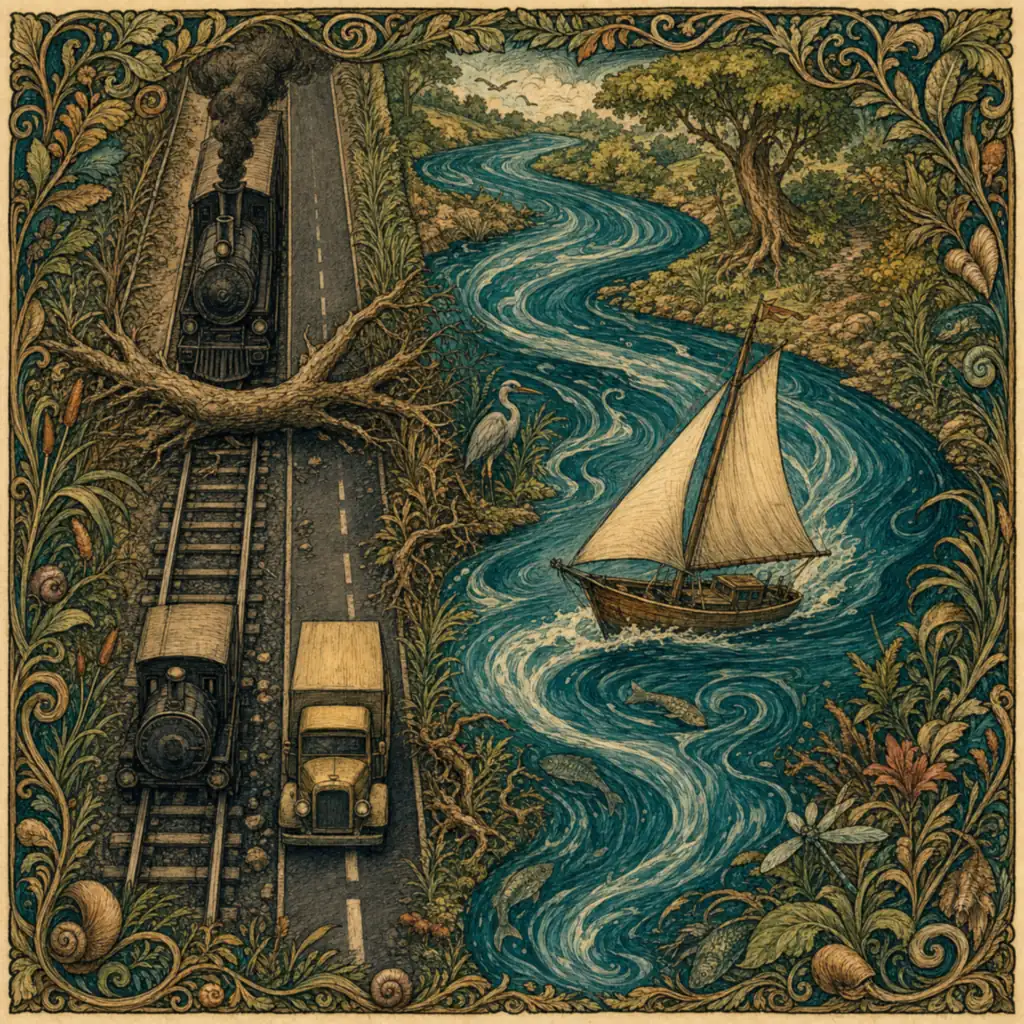
Modern life is dominated by a linear logic
Modern life is dominated by a linear logic that focuses on seeking to understand cause-and-effect and perform analyses under artificial circumstances, making an abstraction from the context determined by time and place, while ignoring the realities of emotions and social frameworks that affect reality. While we are, for instance, aware of the fact that a patient who wants to get better stands a better chance of healing, we continue to study the performance of pharmaceuticals solely using the narrowly defined cause-and-effect approach.
The desire to control the approach to production and consumption based on this tightly controlled linear logic taking us from A to B, has given rise to the management tools that currently dominate our society and the economy. This has forced everyone to translate even basic initiatives into the logic of business plans, using Excel spreadsheets to define marketing strategies based on independent data which has been mined by third parties, and to transform these into a rigid form of supply chain management that squeezes all (perceived) inefficiencies out of the system – while creating unintended consequences. This abstraction forces everyone in competitive markets (which are often not functioning as intended) to focus on producing a limited number of products, and to compete on the basis of quality or cost. This puts a strong premium on cutting costs, including through the achievement of greater economies of scale. All core decisions are made on the basis of this simple linear logic.
The web of life does not follow a linear approach
However, in closely studying Nature as our ‘Master’, we realise that the web of life, both as an ecosystem and a social system, does not follow a linear approach. A caterpillar that transforms into a butterfly undergoes a metamorphosis that cannot be grasped by linear mathematics, as it is a non-linear transformation. In Nature, there are numerous interconnections that have feedback loops and multiplier effects that substantiate many relationships – and these often remain hidden. As we persist in only looking for the shortest and simplest explanation of how “one thing works at one given moment”, we remain unable to grasp the extent of the complex ‘web of life’ where the whole is always more than the sum of the individual parts.
Non-linear behaviour in Nature expresses itself, for instance, in seemingly erratic growth behaviour, such as bamboo shoots that grow into ‘vegetable steel’ in a very short time frame or kelp that grows into high nutrient densities at high speed – an efficiency unrivalled by any industrial process. The extraordinary growth and transformation of species are naturally contained by self-imposed limits. A bamboo plant will grow to a height of 25 meters in a few weeks, but due to the forces of gravity and its genetic memory its unbridled growth will be checked so it does not reach to 100 meters and then 200 meters, even when water and nutrients are available in abundance. Natural systems have clearly defined highly dynamic frameworks within which they operate – where the calculus to restrain growth is as inspiring as the unbridled original growth and transformation that appeal to our imagination. Non-linear approaches to growing a business and responding to societies’ needs, help us understand the true impact of our actions and the remarkable opportunities that are within our reach to radically transform the reality around us.
Operating within the carrying capacity
While natural systems always operate within clear boundaries determined by their carrying capacity, with controls in place to limit expansion, our current economy has yet to do so. As a result, much of our growth is based on production and consumption at a rate that not only exhausts our present reserves while generating waste and pollution, but also deprives future generations of access to these resources. The Blue Economy therefore adheres to a non-linear approach, where growth variables are supported to accelerate and transform faster than considered viable under the traditional linear growth models – while at the same time imposing checks and balances. These permit us to operate within the carrying capacity of the territory in which the project is operating and the greater planetary boundaries, building up the quality of the Commons that we all share, strengthening social capital and enhancing resilience.
This is the reason why all Blue Economy project designs are subjected to a systems dynamics methodology based on the modelling approach developed by Professor Jay Forrester at MIT (USA). In the early 1970’s, this approach served as the backbone for the report presented to the Club of Rome, in the book Limits to Growth. The application of this approach allows us to identify multiple revenue streams, feedback loops and multiplier effects that offer insights that typical linear models like business plans laid out in an Excel spreadsheet, are not capable of providing. This approach is not only a tool for analysis, offering clarity on the long-term impact and potential, it is also a decision-making tool that openly embraces innovations and initiatives while rendering them transparent and reducing risks.