
Residue is part of every natural process
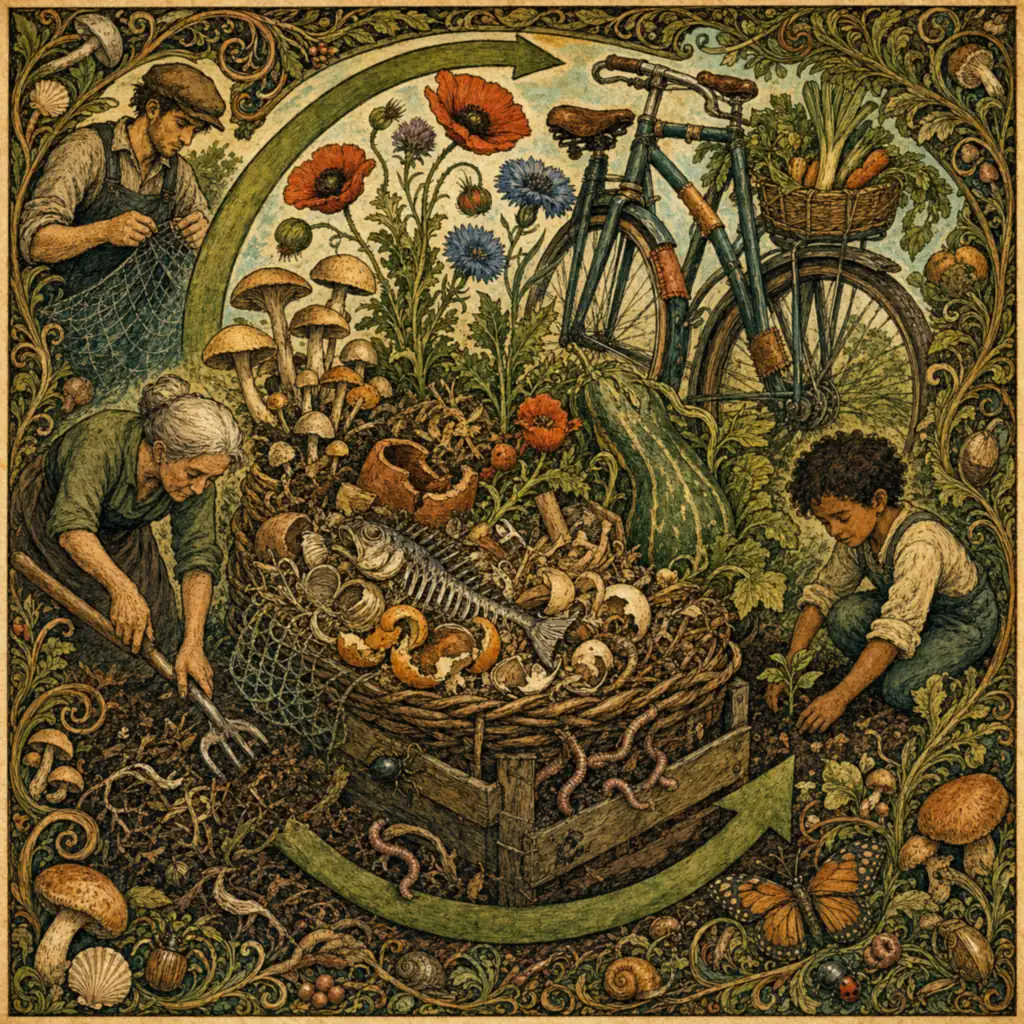
As I have stated, the linear process of production and consumption, focusing on a few isolated priorities, creates a lot of waste. The narrow focus on global supply chains, outsourcing, and distribution centres handling the final product for sale considers everything else as of secondary importance. There is nothing wrong with the generation of residue, which is part of every natural process. The key is that the residue should not be wasted, and whatever is a leftover of one process is converted to an input for another process. This principle can be extended to all flows of matter, nutrients and energy. When we believe that everything has value, we can go beyond the mere recycling of residues, beyond putting waste in a cycle, and give it real value, even with things like weeds and stranded assets. If we agree that potentially everything has value, but not everything has to have financial value, then we change our perception of many resources. This approach creates the opportunity to convert whatever is around us, even wastes that contaminate our air, water and soil, and objects of no relevance to our knowledge into something that generates value.
Everything has value, and everyone can create value
The present model of streamlined production and standardised consumption creates a lot of redundancies – where even human resources are often considered without value. It is within this context that a Blue Economy approach not only assumes that “everything has value,” but also that “everyone can create value.” This insight permits us to design production and consumption systems that are not only capable of responding to basic needs, but also make use of basic resources widely available at low cost, with someone getting paid for accepting the waste and the liabilities associated with it. This generates jobs, which permit people to be part of society while deploying their creative minds and contributing to the best of their ability. This allows everyone to evolve beyond their best.
Creating ongoing value from stranded assets
Residue is not only limited to biological waste and the poor mobilisation of human resources. To address the lack of basic goods and services, a Blue Economy also needs to find ways to create ongoing value from stranded assets. Capital investments in facilities accumulated over the years lose their value when markets shift, say in response to the dangers of certain products, like asbestos, PCBs, and fossil fuels. These defunct installations are all too often left behind through planned bankruptcies, leaving the clean-up to society, at high cost. A Blue Economy approach searches for ways and means to generate new uses for these assets that go beyond, for instance, the recycling of the scrap metals or recovery of leftover materials. Hence a Blue Economy approach offers new insights into how to offer new life to abandoned facilities, enabling workers who have lost their jobs to retrain and contribute to rebuilding their community. This approach also promises a full clean-up of the site over the years to come, so that it stops being a threat to public and environmental health, and finally puts a local area back on track.
Novamont, and the thistle once considered a weed
As will be discussed in Chapter 11, an early leader is Novamont, the Italian pioneer in bio-polymers, who has spearheaded such an approach by converting abandoned petrochemical plants into platforms for the creation of value from readily available local resources, such as cardoon, an artichoke thistle. These stranded assets now provide the core infrastructure on which to build new facilities for the production of polymers, elastomers, lubricants and herbicides, using a renewable local biomass. Once considered to be a weed, the thistle used now creates multiple revenue streams and has turned the local economy around, while creating a competitive force in the chemistry market. By 2020, Novamont had converted five stranded assets across Italy, establishing a new biochemical industry that has become key to the re-industrialisation of the European economy.