
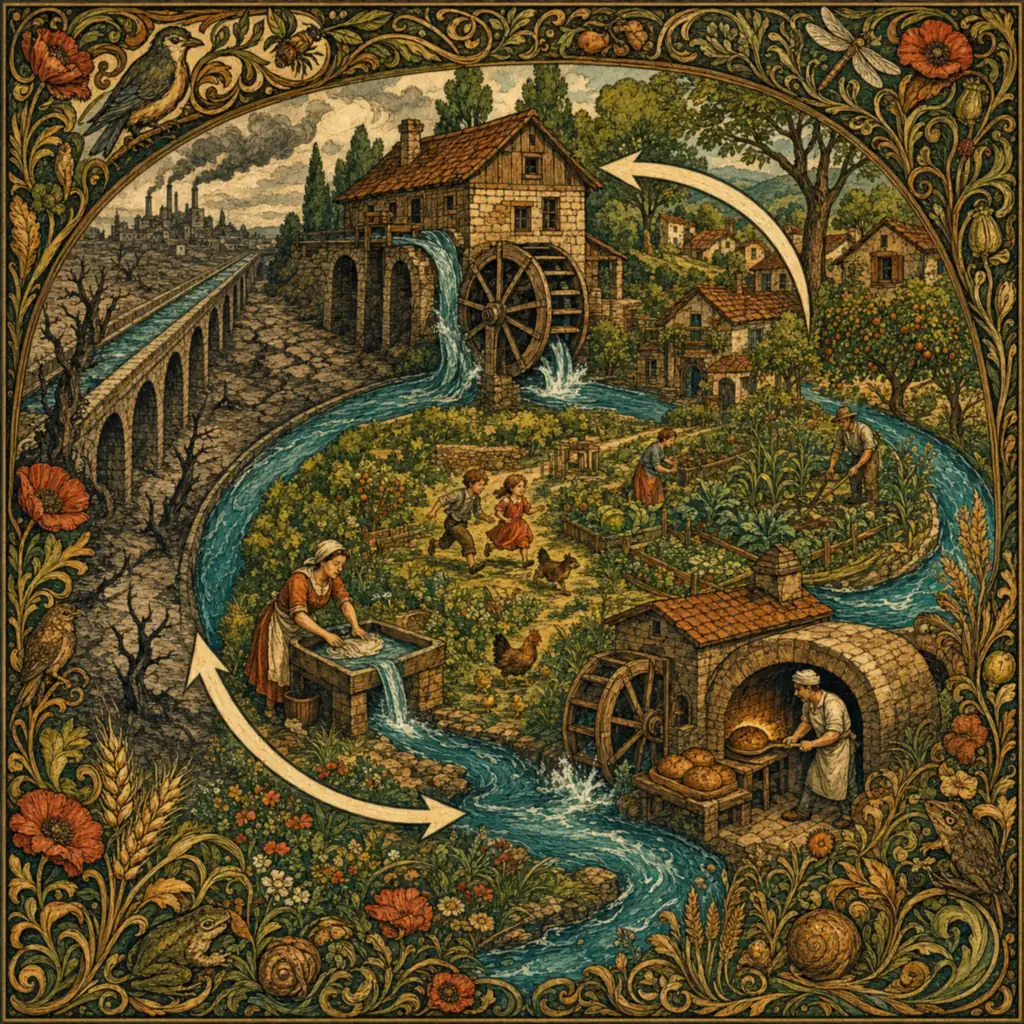
Money quickly leaves the community
The traditional business model has embraced supply chain management, which advocates firm control over every aspect, from the raw materials (sourced wherever is cheapest globally), all the way through to delivery to the consumer. This has been successfully achieved through outsourcing and delegating responsibilities to a select group of suppliers and logistics companies. This has resulted in the creation of global markets for each input or activity: for ores from mines, planted trees or grain harvests, which are traded around the world, with prices set through commodity exchanges. This system means that when a business accesses these commodities the money quickly leaves the community and disappears into the global financial system. An increasing amount ultimately resides in cyberspace even in cryptocurrencies.
Commodities are traded with no concern as to where they finally end up. Once these raw materials are traded and processed, then there is a secondary global market for purified metals, pulp for paper, and flour for bread and biscuits. Next the gold ingots or the steel sheets, the paper rolls and the industrially blended bread are traded on a different set of world markets. Next the metal sheets are pressed into car bodies, and the paper rolls into books or packaging, and the biscuits are branded and traded yet another time across the globe. We are trading everything all the time, all around the world, to the extent that distribution and logistics have become some of the most important sectors of the world economy, steadily increasing the use of polluting fuels and contributing to horrendous traffic jams in and around our megacities.
The creation of at least three and often even four or five ‘horizontal’ markets means that at each horizontal level, residue is generated, goods are traded, options are created and hedging takes place to reduce exchange risks for the financial partners. The result is that by the time gold dust particles are integrated into medical or electronic equipment, or notebooks are delivered to schools, or biscuits are bought in the supermarket, all ingredients have travelled around the world several times. Even though the implications of this in terms of cost of transport and carbon dioxide emissions are absurd, the current business model does not see any harm in it!
Linking the supply chain locally
Following The Blue Economy approach, however, means that the focus is on local economic development, using locally available resources first (even some that have not been considered resources before), and responding to local needs and markets first. This approach rests on linking the supply chain locally from raw material to finished product wherever possible, across the local economy – from farming, fishing, forestry and mining to industrial production. This leads to genuine local economic growth that sees the value added by local businesses retained in the local economy. The approach also eliminates significant expenses related to global sourcing, such as excess packaging, the need for preservatives, and the logistics of lengthy transporting that not only impact the cost of product (requiring costs to be cut elsewhere) but also generate unnecessary waste and emissions.
Why pay for something we can create better ourselves?
The basic question is: “Why pay for something to be brought into the community that we can create better ourselves?” At first this seems like a pointless question but as one steps into a Blue Economy approach new opportunities arise. A now famous example is that of the Island of El Hierro (introduced in Chapter 4). Led by the then Deputy Mayor, Javier Morales, El Hierro redirected part of a €9 million annual diesel bill to invest in wind power, with freshwater pumped by hydropower. Combined with the creation of cooperatives dedicated to fishing, farming and manufacturing, this has reinvigorated the island’s agriculture and created 1,250 jobs, where such jobs were considered lost and where the dependence on imported diesel was likely to place even greater pressure on the local economy in the future.
Prioritising the growth of the local economy and strengthening the networks of local businesses, is why Lung Meng can produce stone paper at low cost in China, and why Novamont is competitive in biopolymers in Italy, since it can source directly from farmers. These cases show that the integration of local resources such as rocks and weeds, with final products in the form of a notebook or a capsule for coffee, ensures that all the unnecessary costs are eliminated, while the value added through design, addition of labour, and conversion of residue to value, increases the local circulation of money. This approach triggers the multiplier effect where money circulates through the economy rather than leaving it as soon as the first transaction is completed – for instance: the person who was paid to take the coffee waste from the café then buys a meal (one that includes the mushrooms or chicken products that are derived from coffee) at the local restaurant. It is obvious that the mushroom and chicken farmers also head to the café for a coffee.
Spirulina, farmed on a rooftop
Let us look at the case of the local production of spirulina, this superfood that has become popular amongst health conscious citizens. Saumil Shah of the company EnerGaia in Thailand has demonstrated this approach through rooftop spirulina farms starting with the Novotel Hotel chain in Bangkok. There is a global market for spirulina, with large centralised producers in Mexico and Hawai'i selling to a wholesale market at premium prices. This highly nutritious additive is rich in essential amino acids and trace minerals. Spirulina on the global market is usually delivered dried. When looking locally first, the cost of drying, packaging, transporting (spirulina is often transported by plane) and trading, is substituted by a cluster of farming, processing and consumption.
The fresh spirulina, rather than the re-hydrated globally traded alternative, is processed on site into smoothies as a breakfast power drink for hotel guests. The rest is mixed with fresh noodles produced in the same restaurant. This is generating local value, compared with the globalised business model that focuses on trade. It is not difficult to calculate the difference in local value generation when the 150 kilograms of spirulina is converted into food without drying or transporting, versus the model of specialisation, a focus on core business and global trading. Professor Jorge Alberto Vieira Costa, department head of biosciences at the Federal University of Rio Grande in Brazil, has dedicated three decades of research into how these photo-biorefineries of spirulina and other blue-green bacteria generate jobs, nutrition, material for textiles, and even methane gas and biofuels for power generation, within a local economic context.