
The unintended legacy of chemistry
Modern industry has all too often relied heavily on chemistry, creating hundreds of thousands of different molecules from mostly petrochemical sources. Chemistry has certainly made extraordinary contributions to modern society but it has also left us with an unintended legacy, namely the rising number of plastics with toxic additives recognised as carcinogens, the development of super-powerful greenhouse gases, and growing mountains of waste and even continually expanding ‘islands’ of plastic debris in our oceans, where salt preserves the molecules and seawater prevents decomposition by ultraviolet light. While the pieces of plastics turn smaller and smaller, a thin film of minute particles emerges on the bottom of all oceans. This inventory of unintended consequences requires an urgent response.
Current scientific thinking with regard to responding to the basic needs of society, is shifting towards manipulating biology and designing more complex chemistry, adapted to fundamentally different conditions: soil, light, air, fresh and salt water. The biological approach includes changing genes, embracing genetic modifications, and unravelling genomes. It is alarming that genetic modification is presented as a pathway to resolving the critical problems of modern society. How could the injection of a carrot gene, producing beta carotene, into a rice kernel ever provide sufficient nutrition to several billion people on Earth? While the introduction of golden rice has been heralded as one of the proven benefits of genetic modification, it is astounding that the scientific community remains ignorant of the fact that rice paddies produce micro-algae that are rich in trace minerals, and in concentrations that are multiples of what could ever be achieved by genetic modification. Whenever an innovation is presented without understanding the context, then we can only suspect a pretext to earn commercial profit at the detriment of others even neglecting the opportunities offered by Nature.
Life is subject first and foremost to the laws of physics
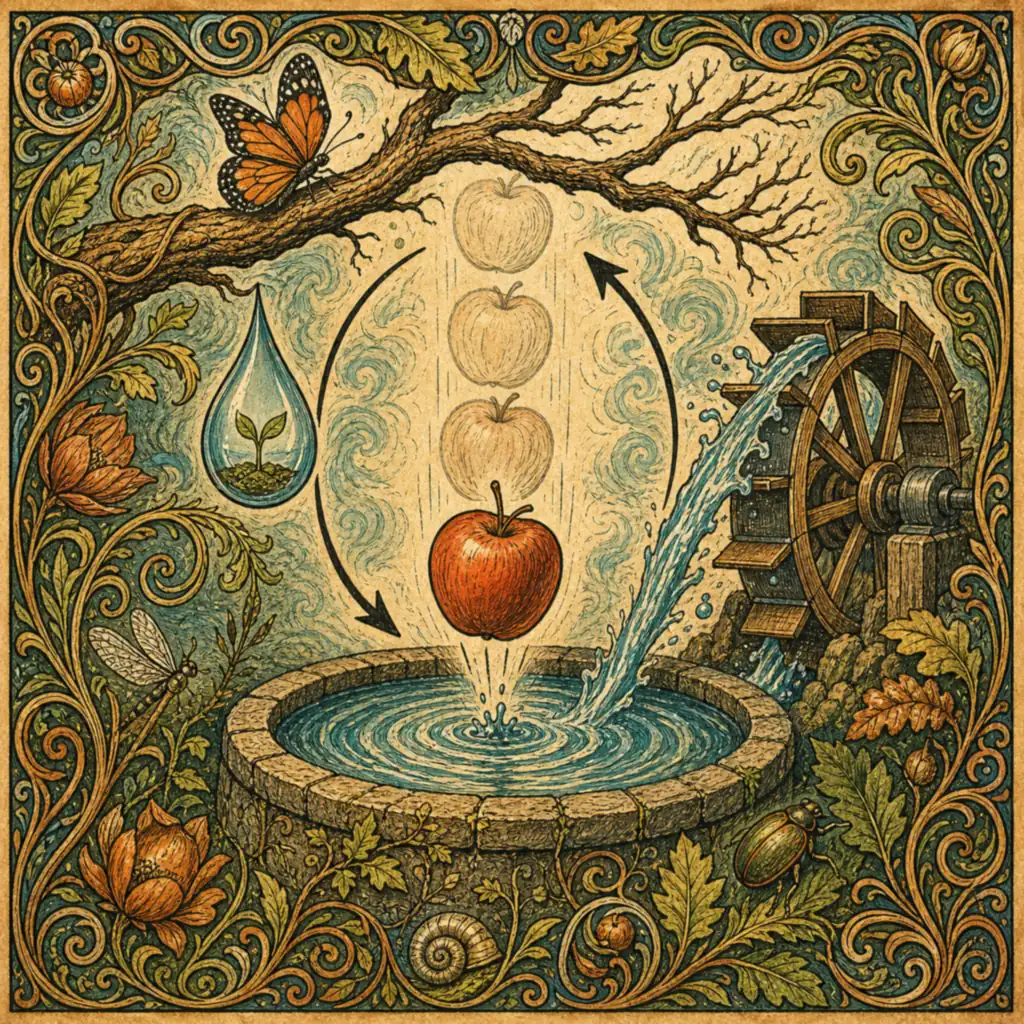
Life is subject first and foremost to the laws of physics, a fact that is often ignored by the scientific community and political leadership. These natural laws are the true guiding principles of all ecosystems. There are no exceptions to these laws: everything always performs according to expectation. Hot air rises, apples fall from the tree at the same speed, and coconuts fill with water according to the lunar cycle. It is unfortunate that we are no longer in tune with these cycles of life, these flows of energy, and these natural powers of the universe, and that the wisdom of ancient cultures regarding these cycles, flows and powers is neglected, even ridiculed and ultimately being lost. The First Nations, custodians of ecosystems not only understand these cycles, over millennia they have learned to listen to plants and animals, observe fungi and algae and derive from these observations ways forward for their communities.
For some reason we have come to believe that we hold the power to direct life as we see fit, and that we know better than Nature. The ecosystems have the capacity to provide for everything that life needs to thrive. And yet, people are prepared to destroy it for money. Worse, humans are ready to kill other humans to control a rock or a piece of land. Observations on how ecosystems operate, allow us to design production and consumption systems, and the built environment, that make best use of the laws of physics, ones that offer predictable results and in the process reduce risks. Application of the laws of physics also reduces the surprise and the burden of unintended consequences.
Natural powers that are guaranteed to work
The Blue Economy suggests that business embraces natural powers that are guaranteed to work. When exposed to heat air and solids expand, and this allows us to design heating and cooling systems that will function without the need for pumps. This is how Anders Nyquist designs houses that are energy-efficient and healthy to live in, cycling air. And once we master the flow of air, we can master humidity. Insights into the laws of physics allow us to utilise differences in temperature, pressure, humidity, alkalinity/acidity (pH) and salinity, to generate abundant flows of energy, predictable in size and magnitude, and locally available. Once we understand that these differences, that are always present, create natural forces, then we can design production and consumption systems that ‘go with the flow’, instead of trying to create the flow at high cost. Reflecting on this, I can see that this logic applies to both the natural world and its inhabitants. As long as I have tried to be the change agent, I expended too much energy on attempting to create a flow or change the current in the direction I saw best for society. Once I realised that there are under-currents and waves that are created in society, irrespective of what I do, I became able to effortlessly surf the waves. It was only then that I really started to see things being accomplished. By 2026, our teams have implemented over 200 projects often against all odds, but always riding the waves, joining the willing, thriving thanks to the forces (and the financing) locally available.
Las Gaviotas, a process based on physics
The laws of physics are beckoning, offering us forces that will allow us to achieve targets and goals previously considered costly or too energy-intensive. We should therefore, in seeking a portfolio of solutions, first explore the opportunities offered by physics. In the case of Las Gaviotas (discussed in Chapter 4), we see the regeneration of the rainforest in the Vichada of Colombia being made possible by the discovery of the laws of physics, specifically related to creating a temperature difference and the control of evaporation of moisture, which enabled trees to survive on denuded land. In planting the first pine trees, the primary goal was not to populate the area with pines and certainly not to introduce a monoculture, but rather for the pine trees to create a biological cover to protect the soil from permanent denudation via exposure to ultraviolet rays. Seeds, once they were protected from the destructive powers of ultraviolet light, could now germinate and biodiversity re-emerged. Scientists who had advised against the project had rightfully argued - with their knowledge and science - that no tree would ever survive this harsh environment. We welcomed their “outdated” input as it led us to finding out how Nature goes about creating conditions that promote and even restore life.
The pine tree was selected primarily for its survival capability, and also for providing shade, a factor that triggered another major change in the local ecosystem. The tree cover protects the soil from sun and rain and a symbiosis with nourishing mycorrhizal fungi changed ambient temperature. As long as the soil was hotter than the rain, the rain landing on warmer soil would splash, re-evaporate and not penetrate the soil, depriving emerging plant and animal life of water for the nine dry months of the year. With tree cover, the soil was now cooler and the rain quickly filtered into the soil. Water now percolated through the delicate layers of a thin ‘skin’ of earth, enriching the (mineral free) rain water. In doing so, it now provided high-quality drinking water to the local population with decaying plant debris, improving and ensuring healthy living conditions. And there was more: this extended green island in a vast area comprising of 20 million hectares of dry savannah, formed a cool spot where any cloud floating over it, was more likely to shed its excess humidity, resulting in more rain, replenishing the groundwater faster than considered viable. This process of regeneration of the source of drinking water through the replanting of a monoculture that evolves into a biodiverse rainforest, is inherently a process based on physics.
In applying our knowledge of physics to our advantage, our actions and methods have led to the soil being enriched by water and nutrients, thereby allowing chemical and biological processes to unfold unhindered and convert a once desolate place into a thriving Nature reserve — one that will continue to evolve into an increasingly diverse biome for centuries to come. It has also created a community of healthier and happier individuals, a fact we discuss later in the book. Unless we understand physics, we will not be able to grasp the opportunities before us to steer society towards sustainability.