
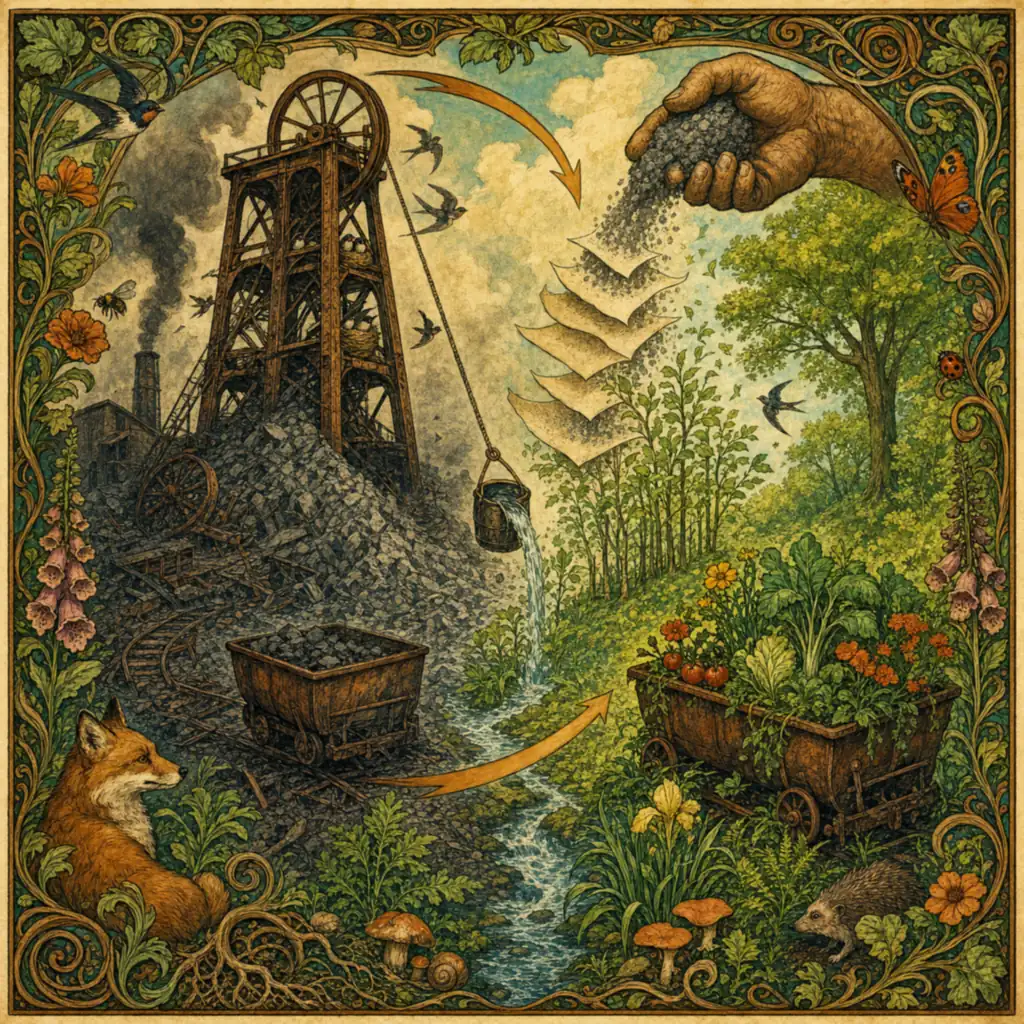
From an expense per tonne to a raw material
Negative and stranded assets, which are covered through provisions, can be converted into investments and even cash generating instruments. Tailings from mine waste dumps, for which provisions were made and ongoing costs are borne by the mining company, can now be converted into raw materials for paper, thus turning waste disposal into a positive cash flow. Over the years, this liability will begin to provide positive cash flow, turning tailing dams from an expense of US$ 25/tonne to a raw material generating revenues of US$ 200/tonne. Considering that mining companies have millions of tonnes of tailings, this could become a major capital gain, if the company so desires. Companies which have been over-leveraged can now strengthen their balance sheet, not through asset stripping, fire sales, closures or divestments, but through putting value on something that, according to the traditional business model (and accountants), has no value.
A fresh start for stranded assets
Stranded assets could also have a fresh start, even those fully depreciated. As we know, any old industrial site runs the risk of requiring a massive clean-up, which can be expensive. If sites with well-maintained, infrastructure could be cleaned-up over time through new activities that generate cash flows, like the case of the petrochemical refinery on the island of Sardinia (discussed in Chapter 11), that was converted to a bio-refinery to process a local weed. This then offers the opportunity of major capital gains over decades, eliminating the need for a full provision on the day of the announcement of closure. Such opportunities can be quantified case by case, through the basic tools of accounting. The secondary benefits include increasing the buying power of the local population, speeding up the circulation of money in the local area, while converting an operation from something that damaged Nature to something that is in harmony with Nature and which allows it to return to its evolutionary path of the economy and the ecosystems.
Spent coffee grounds, burnt or turned into food
Say a major instant coffee producer based in the outskirts of Johannesburg (South Africa) believes that the best way of dealing with the millions of tonnes of spent biomass after the extraction of the soluble part of coffee, is to burn it for energy, then at best one can calculate an investment of X against a savings in energy costs of Y, where payback periods of 8 to 10 years are considered a good result. This is better than sending it to a landfill, and is indeed to be applauded, but it can, however, do better – much better. If the same company were instead to use 100,000 tonnes of spent coffee grounds, recently processed under the most stringent hygiene conditions, to cultivate 10,000 tonnes of mushrooms, it would more than double the profits of its coffee operations. The residue of the coffee would also represent an additional 50,000 tonnes of chicken feed, providing a wide range of nutrients and significantly helping with food security. Job generation would run to as many as 1,000 to 2,000 jobs, injecting money into local economies in a way that the adherents to the incineration approach could not even begin to imagine. The same capital investment in burning the residue could instead be deployed to generate food. While shareholders of a company making instant coffee may not see the value of entering the food and farming business, they will surely not object to increased revenue, not to mention the multiple benefits for the community operating the factories.
From dried mushrooms to a family soup
The amount of mushrooms will exceed local demand. Considering demand for quick, cheap and healthy food, the company selling coffee is also selling instant soups. The availability of dried mushrooms creates a window to introduce a highly nutritious local vegetarian version of the dried soups. The top 80% of mushrooms will be sun dried and turned with locally farmed vegetables into a sachet that satisfies the family needs on the market, under a well known brand. The remaining 20% which does not meet the quality standards, are kept by farming communities that turn this into a solid protein-base for their consumption. This is how the social, ecological and business logic can meet and where the international quality standards can ensure that there are multiple benefits for all. This project potentially uplifts 800 farmer families and secures basic nutrition for over 500,000 people. This is more than anyone ever expected.
Results regularly beyond expectations
As is often the case when taking a Blue Economy approach, the results are regularly beyond expectations. As discussed before, the Las Gaviotas case demonstrates that this integrated approach leads to another accounting success: the increase of biodiversity. Then, there are the statistics on health, with gastro-intestinal diseases dropping to next to nil. The introduction of free drinking water for the local population, and bicycles as the preferred means of transportation, cut the rates of diabetes next to nil. The simple logic rendered the local communities so healthy that the local hospital needed to be closed, due to the lack of patients. At the same time, the site that was acquired for next to nothing in a land program, was valued 25 years after its acquisition, according to an expert team from JP Morgan, at more than a thousand times its purchase price. This put the local community amongst the members of the middle class – within one generation.