
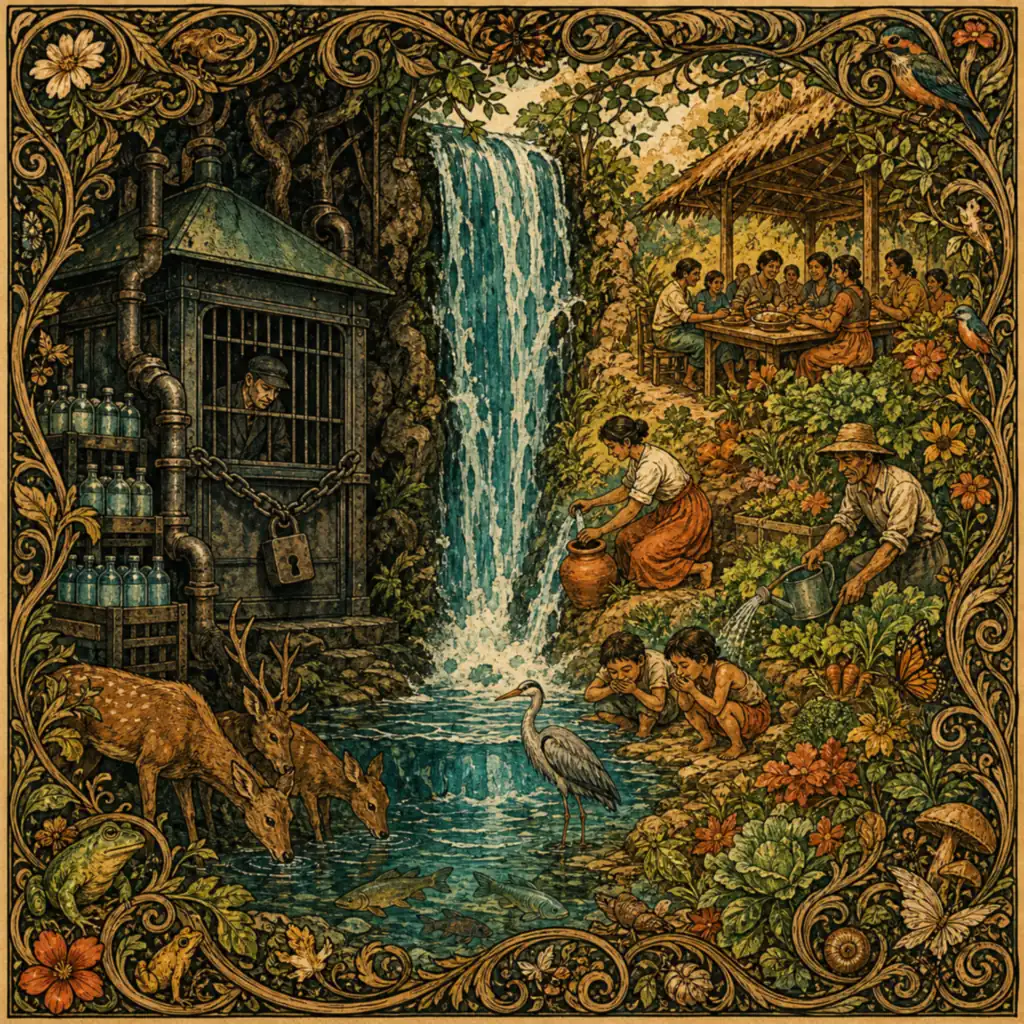
What Nature delivers, for the Common Good of all
Once we realise that we have the ability to transform interconnected problems into portfolios of opportunities – just as it happens in Nature – we will be able to respond to the basic needs of all, with products and services that are strategic for life, and that can be made available locally at much lower cost – for the Common Good of all. There is a compelling logic for this. Nature does not only deliver air, food, water, chemicals and minerals, but also genetics, medicine and beauty. It regulates climate, decontaminates and mineralises water, and converts residues into food. Nature prevents erosion, maintains soil fertility, pollinates, and balances pests and populations. It maintains life cycles and genetic diversity. These enhance life and enable us to all share in what we have. It is unfortunate that the Natural Commons are at best neglected, at worst exploited; pasture is overgrazed and air polluted. What is even worse is that some believe they are entitled to take from Nature all they can, without offering it any respite to strengthen its capacity to cope with excessive demand. Even more disconcerting is when services provided by Natural Commons is privatised and monetised, like the supply of drinking water. How can we offer for profit what is needed for life?
The Commons, exploited beyond replenishment capacity
The Commons, such as spring water aquifers, are exploited beyond replenishment capacity, often turning water — the essence of life that belongs to all — into a commercial product that is bottled (mostly in plastic bottles) and shipped all around the world. Genetics is up for grabs (with many ‘inventions’ being nothing more than a discovery of what Nature designed and created millions of years ago), with the sole purpose of exploiting it for commercial interests, thereby reserving access to it for only those who are able to pay. It is alarming to see how bees and other insect pollinators are affected by the ill-considered and unregulated use of toxins. While the unintended consequences are viewed as collateral damage and written off, such companies retain their licences to operate, and continue to damage the Commons in the name of so-called progress and productivity. When will people realise that without a free pollination service there would not be any fruit, vegetables, wine or nuts on our dinner tables? Or, should pollination be turned into a private and commercial service only?
Soil, the thin skin of the Earth
Soil, and the continuous generation and mineralisation of top soil is another part of our Natural Commons that is critical for our long term survival, and yet it is mostly neglected. It seems that a blind belief exists that genetic modification, hydroponics, laboratory created nutrition, computer systems with AI and satellite surveillance of changing weather patterns will help create all the food required to feed nine billion people. The hard reality is that without soil rich in carbon, or ‘black earth’, there will be no sustainable farming for future generations. Soil is now exploited with the simplistic view that one only needs to add nitrogen, phosphorous and potassium to enhance productivity, ignoring the fact that a wealth of micro-organisms, each with a very specific role in Nature, thrive in topsoil, which we call the ‘thin skin’ of the Earth.
Land and sea are not only over-utilised by current farming and fishing methods, nutrients are consumed without replenishing them, forests are considered tree farms, are consumed without replanting with biodiversity. This leads to unbalanced climate conditions, as a result of dramatic temperature increases and the acidification of air, water and soil. It is with this understanding that a Blue Economy approach ensures that any new initiatives empower Nature to maintain its capacity to offer free and abundant products and services, that range from soil, food and water, to beauty.